Home Blog

Kalanggaman Island’s Inclusion In ‘World’s 50 Best Beaches’ Feted

Tourism officials in Eastern Visayas are celebrating a major global milestone after Kalanggaman Island in Palompon, Leyte, debuted at 25th place on the prestigious World’s 50 Best Beaches list for 2026.

Kalanggaman joins El Nido’s Entalula Beach – which claimed the top spot worldwide this year – as the only two Philippine destinations to make the elite rankings.

Unlike popularity-based polls, the list is curated by travel professionals who evaluate beaches for authenticity and natural condition.

Palompon Mayor Mary Dominique Oñate called the recognition a “proud moment,” attributing the success to the town’s strict environmental management.

“This achievement reflects the dedication of our community in protecting Kalanggaman. As we gain global attention, we remain committed to safeguarding its unspoiled beauty,” Oñate said in a statement Monday.

To preserve the island’s famous white sandbars and turquoise waters, the local government enforces a strict limit of 500 visitors per day.

Department of Tourism (DOT) Regional Director Karina Rosa Tiopes said that although locals have appreciated the island’s beauty for a long time, this international attention will greatly increase interest in the wider region.

“The world is finally seeing what we have quietly known for the longest time,” Tiopes said, adding that the ranking, followed by millions of travelers, brings the responsibility of heightened sustainability.

“We must work even harder to manage visitor numbers and improve facilities while protecting the environment,” she added.

Accessible only by boat and with limited infrastructure, Kalanggaman was praised by judges for its long, narrow sandbar extending into open water, remaining pristine due to regulated tourism. (PNA)

Catbalogan Eyes Tourism Boost Through ‘Food Trip’ Experience

0

The city government of Catbalogan in Samar is putting its rich culinary heritage in the spotlight with the launch of a new food tourism initiative to attract visitors through a curated “food trip” experience.

Labeled as the Secret Kitchens of Samar Food Crawl Series: Flavors of Catbalogan, the program was introduced in partnership with the Samar provincial government. It aims to showcase Catbalogan’s diverse flavors and local dining spots, highlighting its status as a top food destination.

The food crawl is an immersive, multistop experience that goes beyond dining, offering a narrative journey into the province’s culinary heritage. It highlights traditional recipes, local ingredients and the stories of the people behind each dish.

At the center of the carefully curated food crawl are well-loved eateries and hidden culinary gems across the city. Among the featured stops is the Catbalogan City Market.

At the local market, visitors can sample traditional dishes like pakdol (savory carabao meat soup) and lomo (pork, liver and intestines soup), along with rice delicacies such as suman (rice cake) and puto (steamed rice cake). Also included is Tina’s Garden, known for its halo-halo and pork sandwich.

Another highlight is Charito’s Delights, where visitors can buy “pasalubong” items such as pili-based delicacies and local specialties like tamalos (tender pork belly bathed in a thick, spicy, peanut-based sauce), baduya (deep-fried) nga pasayan (shrimp) and baduya nga ube.

Also on display are innovative ice cream flavors such as lemongrass, ginger and avocado. Seafood lovers can also enjoy a variety of tahong (green mussel) dishes—from fried and grilled to lumpia-style preparations.

Other featured stops include Tony’s Kitchen, popular for ugat, kueking and patatim; the Palabok House by Haropoy, which serves local favorites such as odelas, hinaplag and callos; and the Bularan Strip, which offers a wide selection of dried fish products.

Officials from the Department of Tourism, including Assistant Secretary Christine Joy Cari and Regional Director Karina Rosa Tiopes, commended the initiative, noting that food plays a key role in shaping how travelers experience and remember destinations.

“We are not just showing dishes—these are stories we grew up sharing at family tables, in kitchens, during fiestas, and even on ordinary days. By showcasing Catbalogan’s secret kitchens, we are honoring our ancestors while opening opportunities for our communities today,” Cari said in a statement on Monday.

Samar Gov. Sharee Ann Tan emphasized that the program not only promotes tourism but also supports local businesses and helps preserve culinary traditions.

“Through this program, tourists will surely return — not only because of our delicious food but also because of the stories behind them, cherished and preserved by our families,” Tan said.

To accommodate different types of visitors, three food tour packages have been developed.

The “Pamahaw, Pakihampang ngan Paningudto” package, priced at PHP1,080 per person, offers a five-hour morning experience from 7 a.m. to 12 noon. It includes market visits, bakery stops, restaurant dining, and a demonstration of how tamalos are prepared.

Another option is the “Merienda ngan Pamasyada” package, priced at PHP230 per person and running from 2 p.m. to 6 p.m., offering a shorter afternoon tour that combines snacks with visits to cultural sites such as the city museum and the capitol grounds.

Meanwhile, the “Merienda ngan Panigab-i” package, priced at PHP940 per person, runs from 4 p.m. to 9 p.m., blending food stops with city tours and barbecue dining.

Optional visits to the historic San Bartolome Church are also available with all packages, adding a cultural and religious dimension to the culinary journey.

The initiative also serves as a platform for micro, small and medium-sized enterprises in the food sector, providing greater visibility, expanded market access, and stronger integration into Samar’s growing tourism value chain. (PNA)

Rail, Transport Dominate PHP3.16 Trillion Public-Private Partnership Project Pipeline

The Philippines currently has 252 projects worth PHP3.16 trillion in the pipeline to be undertaken by the government and the private sector.

Data from the Public-Private Partnership (PPP) Center showed that as of Monday, 168 projects worth PHP3.02 trillion will be implemented by the national government while 84 projects worth PHP136.26 billion will be implemented by local government units.

Railway accounted for the biggest chunk with total projects amounting to PHP1.97 trillion, followed by land transport, PHP274.06 billion; and property development, PHP221.46 billion.

PPP data showed that majority or PHP2.02 trillion worth of projects will be implemented by the Department of Transportation, while PHP1.22 trillion worth of projects will be implemented by the Philippine National Railways.

Majority of these projects will be located in the National Capital Region, Central Luzon, and Ilocos Region. (PNA)

200 Pangasinan Residents Build Farm, Reservoir

0

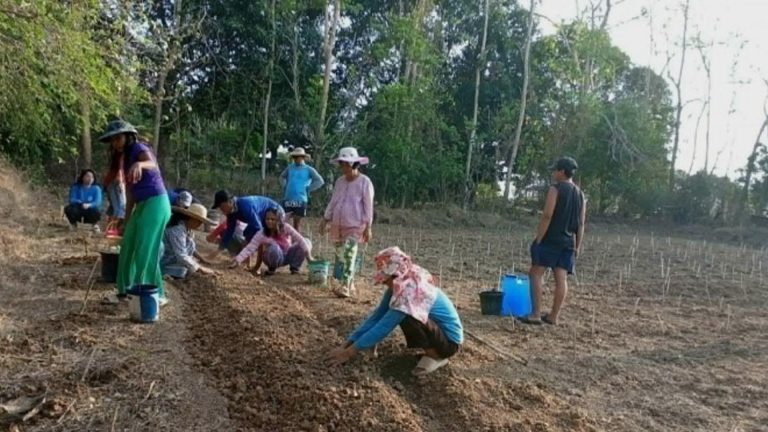
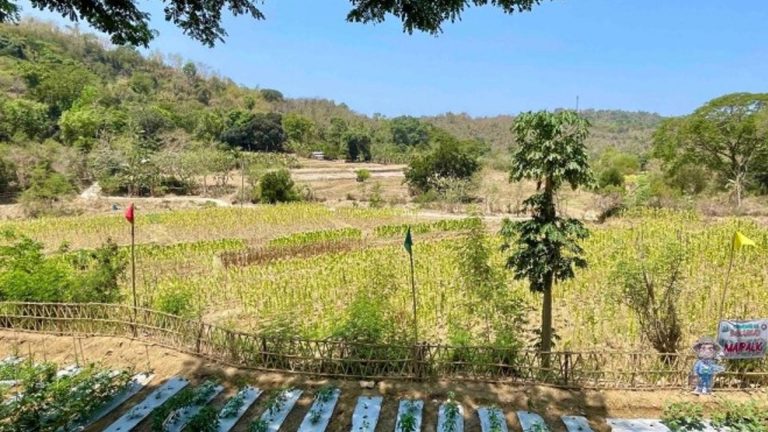
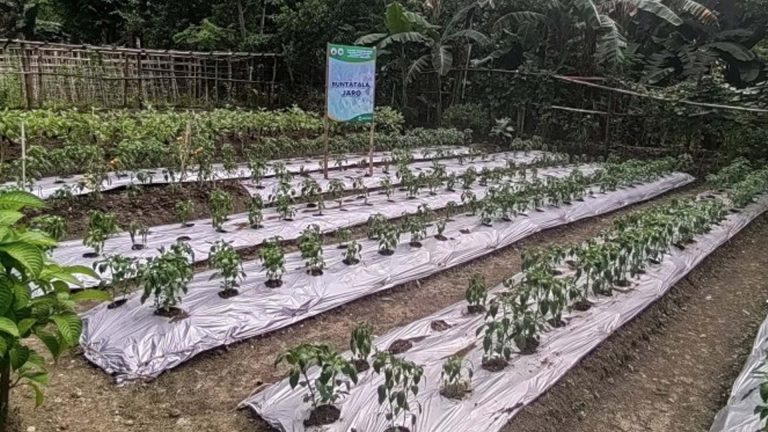
A total of 200 residents of Balungao, Pangasinan have begun building a small farm reservoir, a nursery, and a vegetable garden.

It is part of Stage 2 of Project LAWA (Local Adaptation to Water Access) at BINHI (Breaking Insufficiency through Nutritious Harvest for the Impoverished) of the Department of Social Welfare and Development (DSWD).

The program helps communities adapt to climate change through Cash-for-Training (CFT) and Cash-for-Work (CFW), according to a DSWD 1 (Ilocos Region) briefer for the Philippine News Agency on Thursday.

The beneficiaries undergo a five-day training for CFT, and 15 days for CFW, intended to provide a source of water or food, especially during the dry season, it said.

It also provides temporary income to the beneficiaries with a daily wage of PHP468 for 20 days, or a total of PHP9,360.

This year, the number of beneficiaries is 7,350 from 30 localities across the region.

Beneficiaries are those in target localities that have exposure to climate impacts, with high socio-economic needs, and a high incidence of poverty.

The beneficiaries, identified by the Local Social Welfare and Development Office, are fisherfolk, farmers, indigenous people, and indigents, as well as persons with disabilities and other individuals in informal sectors. (PNA)

Ilocos Norte Braces For Dry Spell

0

The Ilocos Norte provincial government, working with local government units and farmers’ associations, has begun building and repairing small farm reservoirs and water impounding dams to help mitigate the impacts of the El Niño phenomenon, now affecting this part of Luzon.

Governor Cecilia Araneta-Marcos confirmed this at a press conference Monday, reporting that early-maturing varieties of vegetables and corn seeds are also being provided to farmers to enable them to continue cultivating their crops amid water scarcity.

“We are starting to feel the effects of drought so we are prioritizing our support for farmers as well as water conservation measures,” she said.

A portable desalination machine was also purchased for the 4th Marine Brigade at Camp Cape Bojeador in Burgos, Ilocos Norte, to provide them with access to potable water from seawater.

Araneta-Marcos said the provincial government plans to procure additional desalination units for the province’s first and second districts to ensure public access to clean, sustainable water.

In addition, farmers and fisherfolk are advised to secure their crops by ensuring they are included in the Registry System for Basic Sectors in Agriculture masterlist and to strengthen collaboration with concerned government agencies to harmonize solutions to mitigate drought impacts.

The weather bureau recently raised the country’s status from “El Niño Watch” to “El Niño Alert,” signaling a higher chance of below-normal rainfall that may affect irrigation, agriculture, power and health.

The model forecasts suggest an increasing probability of El Niño conditions as early as the third quarter of this year. (PNA)

Why Allan Jeffrey Bacar Walked Away From Stability To Build Sskait

Before the comics reached hundreds of thousands of screens, before the characters became instantly recognizable, there was a version of Allan Jeffrey “AJ” Bacar who followed a path many would consider already set.

An electronics engineer. A graduate with Honorable Mention from De La Salle University. A career in a major telco, working on projects that affected users nationwide. On paper, it was the kind of trajectory that promised stability, growth, and approval.

And for a time, it delivered exactly that.

“I was actually enjoying my job in the telco,” AJ says. “Being given roles to lead and support engineering projects that impact a lot of users nationwide is a privilege.”

The work was demanding. There were sleepless nights, long hours, and the quiet pressure that comes with responsibility. But there was also structure. Guidance. A sense of direction shaped by mentors and expectations.

What it did not fully address was something more internal.

The version of AJ inside that system was not unhappy, but he was not entirely settled either. There was another part of him, one that had existed long before the degree and the job, that continued to look for space.

Drawing had always been there.

As a child, it was how he made sense of things. A way to communicate, to share moments with his brother, his big sister, his friends. Even in college, that instinct stayed, showing up in publication work and small creative outputs that lived alongside academic demands.

He did not begin Sskait as a career move. He began it as something closer to release.

The name itself came quietly. A bus ride. Rain against the window. A passing moment that stayed just long enough to become something else. That pattern would continue in his work. Some of his most recognizable series, from Ulan to Multo Serye to Man vs. Ipis, did not start from elaborate planning. They started small.

“All of it are usually accidental lang talaga,” he says. “I make the comic story as it happens… if a random intrusive thought happen na I think, ‘Parang funny to haha,’ I make it into a comic.”

There is no heavy filtering in that process. No attempt to force ideas into something more polished than they need to be. He creates, posts, and allows the audience to respond in its own way.

That simplicity is part of what kept the work grounded, even as it began to grow.

Because it did grow.

What once existed as something shared among friends slowly reached a wider audience. What used to be a habit became a routine. And with that came a shift, not just in scale, but in responsibility.

Still, some things remained unchanged.

“Whenever I make comics, up until now, I send it to my friends / fam first before I have it finalized and uploaded,” AJ shares.

It is a small ritual, but one that anchors him. The feedback, the laughter, the reactions from people who knew him before any audience did. It keeps the process personal, even when the output is public.

“It has the same feeling of happiness,” he says.

But scale introduces its own realities. What used to be purely creative now includes administrative work, growth strategies, and the unseen labor of maintaining a platform. These are the parts he admits feel more like work.

“It’s a bit challenging, yeah, but it is necessary.”

And yet, the act of drawing itself has not lost its place.

“When I go back sa part of making comics, parang… there are comics that makes me feel at peace pa rin,” he says, especially those rooted in real and heartwarming stories.

The decision to leave corporate was not immediate, nor was it easy.

Security is difficult to walk away from, especially when it aligns with what is expected. His parents, at first, were hesitant about the idea of pursuing art full-time. The risks were clear. The path was uncertain.

“It was really hard for me to move full time to do comics and content creation,” AJ admits.

What changed was not a single moment, but a series of experiences that began to carry more weight.

One of them was simple. Bringing his parents along to meet-and-greet events across the country. Letting them see, firsthand, the places his work had taken him.

“Parang, I felt happy na nalilibot ko sila with me,” he says.

There was also something less visible but more lasting. Messages from people who found comfort in his work. Readers going through difficult moments who saw something of themselves in his stories.

“Marami kang nai-impact na tao positively,” he reflects. “It adds a lot of meaning and purpose to the work I do.”

Still, even with growing validation, there was a point where staying in between two worlds was no longer sustainable.

“The turning point siguro is, when the demand came,” he says.
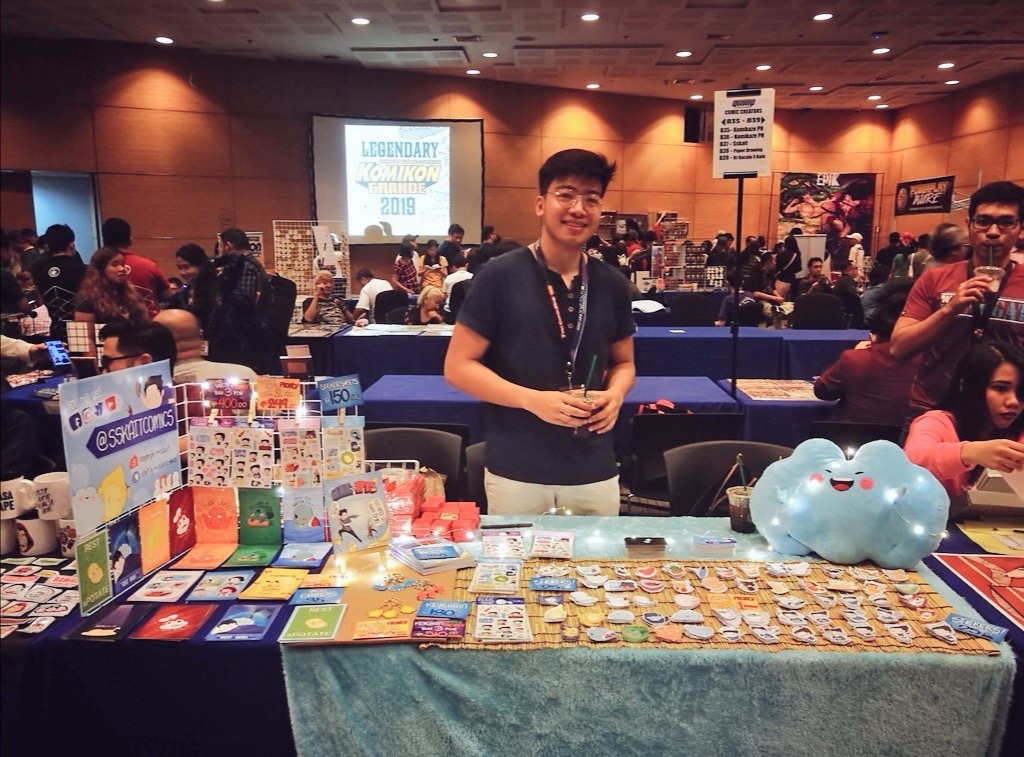
People began looking for him at conventions. Brands started reaching out. The audience was no longer passive. It was active, expectant, growing. At the same time, his corporate role continued to demand time and energy, often beyond regular hours.

“It was challenging na ipag-sabay yung corporate work… sa demand din ng Sskait,” he explains.

There comes a point when something that begins as a side project asks to be taken seriously. Not just in output, but in commitment.

For AJ, that point meant choosing.

Not because he had planned to leave engineering behind, but because what he had built alongside it no longer fit within the margins of his day.

Sskait was never meant to replace anything.

It simply grew until it could no longer remain secondary.

And in that growth, it revealed something many people spend years trying to identify.

Not just what you are good at.

But what you are willing to risk stability for, even when the outcome is not guaranteed.

Iloilo City To Activate Communal Gardens In Barangays

0

The local government here is eyeing the activation of communal gardens in the barangays (villages) in anticipation of the possible impact of the high cost of fuel on food supplies.

City Agriculturist Iñigo Garingalao, in an interview on Thursday, said the initiative is a way to ensure the community have a sustainable food source for its daily needs.

The communal garden started as an edible landscape in barangays, a competition that ran for six years, he said.

‘It is being done in cycles, lasting for almost eight months. The community garden has a component that provides a feeding program for malnourished children in their barangay, and the excess products are sold, giving them a source of income,” Garingalao said.

Last year, close to 90 communal gardens were established, but others opted to temporarily stop this year to allow the soil to recover.

“This year, we target 100 communal gardens even if others will no longer join the competition,” he said.

Garingalao said they have already completed the orientation training last week for communities where the gardens will be established.

‘They plan to start planting by the end of May in time for the early rains,’ he said.

Other than the communal garden, Garingalao said they also have peri-urban, or the small farms usually in the outskirts of barangays, and composed of clusters of associations.

There is also a program for a cluster of barangays that are into vegetable and rice farming.

He said Mayor Raisa Treñas would like to maximize the city’s nursery complex so that they will have a ready source for the community kitchen anytime, should the city government want to provide food to barangays in case of emergencies. (PNA)

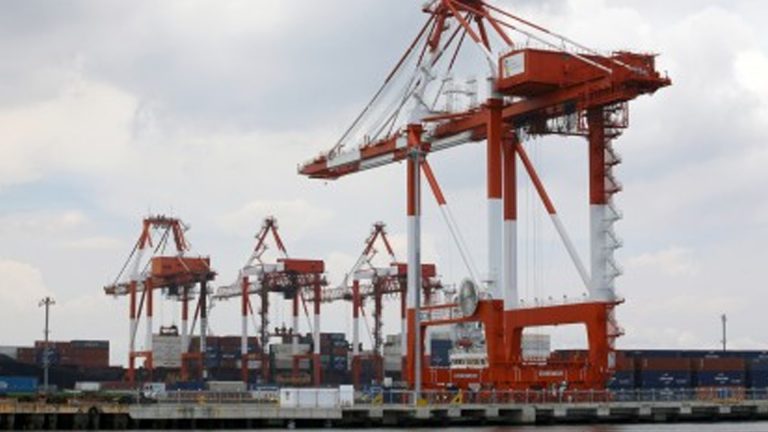
Philippines External Trade Jumps 15.3 Percent To USD20.85 Billion In March

The Philippines’ total external trade in goods rose by 15.3 percent to USD20.85 billion in March this year, up from USD18.07 billion in the same month last year, according to preliminary data released by the Philippine Statistics Authority (PSA) on Thursday.

In its report, the PSA said the total external trade in March was the highest recorded since 1991.

Imports accounted for 60.8 percent of the total, while exports comprised the remaining 39.2 percent.

Data showed that the balance of trade of goods, or the difference between the value of exports and imports, slightly rose to USD4.50 billion from USD4.51 billion a year ago.

Exports continued their upward trend, increasing by 20.4 percent to USD8.17 billion.

Electronic products remained the country’s top export during the month, generating USD4.82 billion, or nearly 60 percent of total exports.

This was followed by machinery and transport equipment, with export earnings of USD 407.22 million, and other manufactured goods at USD402.73 million.

The United States, Hong Kong, Japan, the People’s Republic of China, and Taiwan were the country’s top export destinations.

Meanwhile, the total value of imported goods also grew by 12.3 percent to USD12.68 billion.

Raw materials and intermediate goods accounted for the largest share of imports, totaling USD4.60 billion, followed by capital goods and consumer goods.

China remained the country’s largest supplier of imported goods, valued at USD3.50 billion or 27.6 percent of total imports in March.

Other leading sources of imports included South Korea, Japan, Indonesia, and the United States. (PNA)

Culture Is Now Reputation In Action

0

One of the most important shifts I have observed over the past decade is how reputation is no longer introduced through communication, but experienced through people. There was a time when organizations could shape perception largely through messaging, relying on strong media presence, carefully crafted narratives, and consistent visibility to define how they were viewed. Reputation, in many ways, could be projected outward and reinforced through communication effort.

That approach no longer holds in the same way today. Stakeholders now encounter organizations through direct experience before they encounter any formal narrative. They interact with teams, collaborate with employees, and observe how decisions are made in real situations. These interactions shape perception immediately and often more powerfully than any message that follows. In this environment, reputation is not something that begins with communication. It begins with behavior.

This shift has elevated the importance of culture in ways that many organizations are still fully coming to terms with. Culture is often described in broad and aspirational terms, defined through values statements, mission declarations, and guiding principles. However, in practice, culture is expressed through what people actually do on a daily basis. It becomes visible in how employees respond to clients, how teams work together under pressure, and how consistently standards are upheld across the organization. These actions create patterns that stakeholders observe and interpret over time.

From a leadership perspective, this changes how reputation must be understood and managed. It is no longer sufficient to focus on external messaging as the primary driver of perception. Reputation must be built through internal alignment, ensuring that people understand what the organization stands for and are able to translate that into consistent behavior. When employees are aligned with purpose and values, their actions reinforce credibility in a way that feels natural and authentic. Stakeholders respond to this consistency because it reflects stability and reliability.

When alignment is weak, the impact is equally visible. Gaps begin to emerge between what organizations communicate and what stakeholders actually experience. These inconsistencies are quickly noticed and often interpreted as signs of deeper issues. Trust becomes more fragile because stakeholders rely increasingly on what they observe rather than what they are told. In this sense, misalignment is no longer a minor internal concern. It is a direct reputational risk.

This is why culture must be treated as an operational priority rather than a symbolic one. Culture is not sustained through statements alone. It is shaped through decisions, reinforced through accountability, and embedded through systems that guide how people work. Leadership plays a central role in this process by setting expectations, modeling behavior, and ensuring that standards are applied consistently. Over time, these signals define how the organization operates and how it is perceived externally.

Internal systems also play a critical role in reinforcing culture and, by extension, reputation. Hiring decisions, performance management, recognition programs, and development initiatives all contribute to how culture is expressed across the organization. When these systems are aligned, they create an environment where employees can perform with clarity and confidence. When they are not, they introduce inconsistencies that eventually become visible to stakeholders. While external audiences may not see these systems directly, they experience their outcomes through every interaction.

The importance of this alignment becomes even more evident during moments of uncertainty. In times of disruption, organizations reveal their true character. Employees respond based on what they have internalized, and their actions communicate far more than any formal statement. When alignment is strong, teams act with discipline and purpose, reinforcing confidence among stakeholders. When it is weak, responses become uneven, and uncertainty is amplified. In these moments, behavior defines perception more clearly than communication ever could.

This is why employees have effectively become the first line of reputation. They shape how the organization is experienced in real time, not because they are instructed to represent the brand, but because their actions naturally do so. Every interaction becomes a signal of credibility, and every decision contributes to how trust is formed and sustained. Reputation is no longer something organizations present at a distance. It is something stakeholders encounter directly through the people they engage with.

As PAGEONE Group marks its tenth year, this shift offers a clear lesson for leadership. Organizations that sustain strong reputations are those that invest in alignment, consistency, and internal trust. They recognize that credibility is built through daily actions rather than isolated communication efforts. They ensure that culture is not just defined, but practiced, and that employees are equipped to represent the organization with confidence and integrity.

In today’s environment, reputation is shaped not at the point of communication, but at the point of action. Organizations that understand this will focus not only on what they say, but on how they operate through their people. Over time, these actions create the consistency that stakeholders trust and the stability that organizations rely on.

Reputation, in its most enduring form, is simply culture experienced from the outside.

This is part of a series of articles written by senior leaders of PAGEONE Group to celebrate a decade of excellence in public relations, advocacy, reputation management and marketing communication in the Philippines and Asia Pacific.
Vonj C. Tingson, is the President, PAGEONE Group. He is celebrating his birthday today May 4.

The Day “Forthwith” Lost Its Teeth

0

The most consequential word in Philippine politics today is not a name. It is not a number. It is not even a vote.

It is forthwith.

In its recent clarification, the Supreme Court of the Philippines took a word that once carried the force of immediacy and quietly rewired it. What used to mean act without delay has now been reinterpreted to mean act within a reasonable time. On paper, that sounds like a minor act of legal housekeeping. In reality, it is a fundamental shift in how power moves across institutions.

Because in the context of impeachment, timing is not procedural. Timing is political currency.

The constitutional provision is clear. Under Article XI, Section 3(4), once the House of Representatives of the Philippinestransmits the articles of impeachment, the Senate of the Philippines shall proceed with trial forthwith. The framers did not choose that word casually. They inserted it precisely to prevent the Senate from sitting on an impeachment, from waiting out political storms, from converting accountability into delay.

Forthwith was meant to be a constraint.

The Court has now turned it into a standard.

That distinction is not semantic. It is structural.

By ruling that forthwith means within a reasonable time, the Court has effectively transformed a mandatory command into a discretionary space. It has replaced a hard constitutional trigger with an elastic institutional judgment. In a political system where elasticity is where maneuvering happens, that change matters.

Before this ruling, any delay by the Senate could be framed as constitutional noncompliance. The language of the Constitution itself would have been the argument. After this ruling, delay can now be justified as compliance. As long as it can be argued to fall within what is reasonable, it stands on legally defensible ground.

That is not a small shift. That is a reallocation of leverage.

Because what is reasonable in law is almost always negotiable in politics.

And this is where the decision intersects directly with the impeachment of Sara Duterte. This is not an abstract constitutional exercise. It is a live political contest involving a sitting Vice President who remains central to the 2028 presidential equation. In that context, every day matters. Every week matters. The calendar itself becomes part of the strategy.

The Court’s ruling does not stop the process. It does something more subtle and more consequential. It slows it down just enough for politics to catch up.

And when politics catches up, outcomes change.

To be fair, the Court did not arrive at this interpretation without reason. It recognized institutional realities. The Senate is not a switch that can be flipped instantly. It must convene as an impeachment court. It must adopt rules. It must administer oaths. It operates within legislative calendars, recesses, and procedural requirements. A rigid interpretation of forthwith as immediate could create operational absurdities, forcing action when the institution is not even in session.

On this point, the Court is correct.

It protected the Senate from an impossible command. It reinforced the principle that co-equal institutions must be allowed to function within their own processes. It avoided a constitutional reading that could lead to paralysis.

But in solving one problem, it created another.

Because impeachment is not an ordinary institutional function. It is the Constitution’s most powerful accountability mechanism against high officials. It is designed to be swift not because speed is efficient, but because delay is dangerous. Delay allows power to regroup. Delay allows narratives to shift. Delay allows pressure to be applied, deals to be made, alliances to be tested.

Delay is where impeachment loses its teeth.

By introducing the standard of reasonable time, the Court has opened the door to precisely that risk. It has given legal cover to what can now become strategic delay. It has moved the battleground from whether the Senate must act immediately to how long the Senate can justify waiting.

And that is a much easier argument to win.

Because ambiguity is power.

The Constitution spoke in a hard word. The Court replaced it with a soft one. That shift transfers authority from text to interpretation. It places control not in the rigidity of constitutional language but in the fluid judgment of political actors operating within institutions.

In practice, that means one thing. Whoever controls timing now controls trajectory.

Supporters of Duterte will see this as a necessary correction, a recognition that institutions cannot be railroaded by political urgency. They will argue that due process requires preparation, that the Senate must not be forced into a rushed trial that compromises fairness.

Her opponents will see it differently. They will argue that the Court has weakened impeachment, that it has provided an escape hatch, that it has turned a constitutional command into a negotiable timeline.

Both readings will coexist. Both will shape how the process unfolds.

But beyond these immediate reactions lies a deeper institutional consequence. The ruling subtly redefines impeachment from a constitutional trigger into a managed process. It becomes something that can be paced, calibrated, even delayed within acceptable bounds. It becomes less of a hammer and more of a negotiation.

That may stabilize institutions in the short term. It may prevent abrupt confrontation. It may allow the system to absorb political shocks more gradually.

But it also risks normalizing a dangerous precedent.

If impeachment can be slowed, it can be weakened. If it can be weakened, it can be avoided. And if it can be avoided, then one of the Constitution’s core safeguards becomes contingent not on principle, but on timing.

That is the real story here.

This is not just about what forthwith means. It is about who decides when accountability begins.

The Constitution once answered that question decisively. The Court has now made it conditional.

And in politics, the difference between immediate and reasonable is not measured in time.

It is measured in power.