


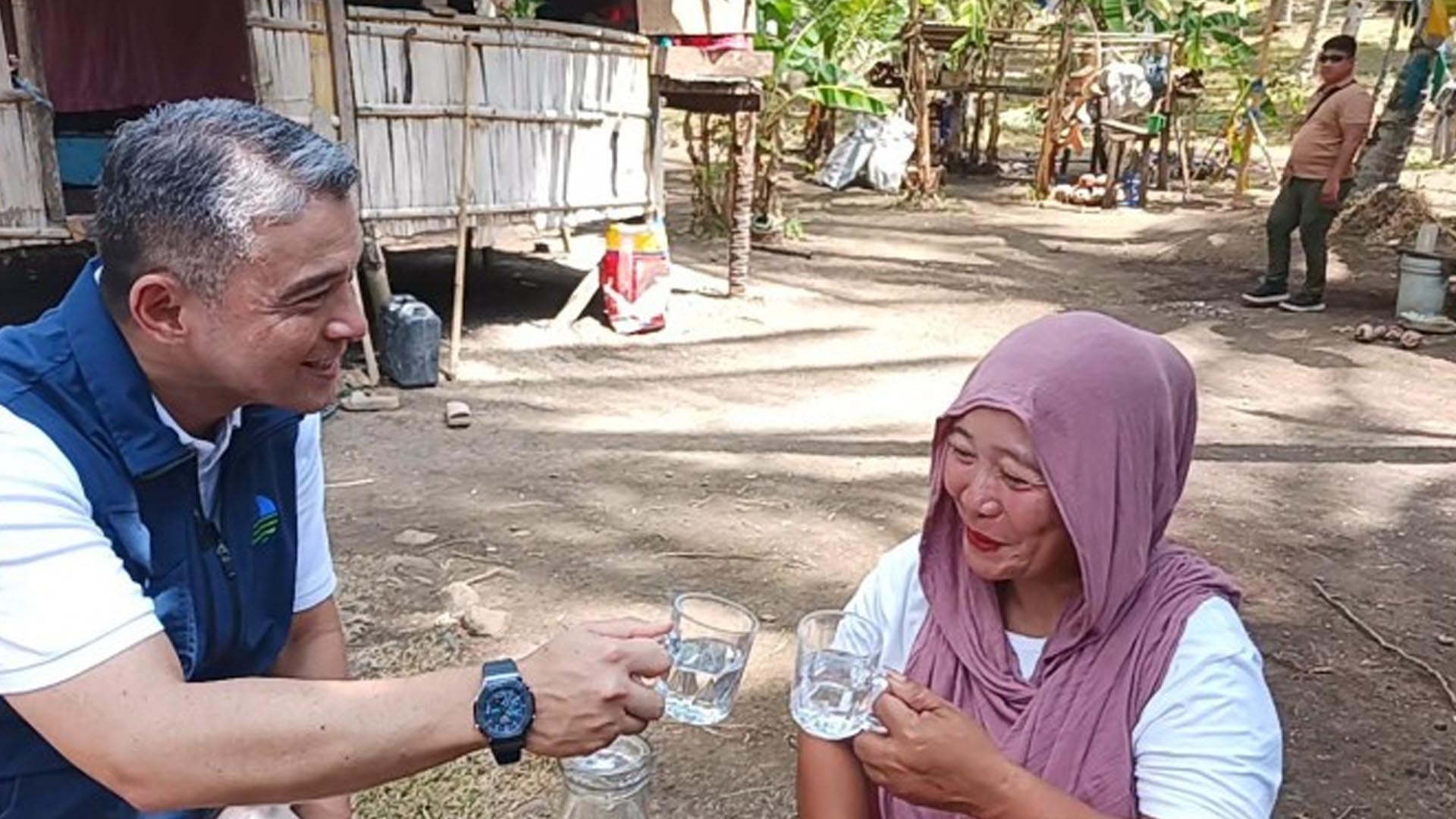







For years access to safe drinking water was a daily struggle for residents of Barangay Tumalutab, a small and remote island in Zamboanga City.
Families mostly relied on deep wells, often unsafe and causing illness, especially among children, or have to shell out PHP60 to PHP70 per 5-gallon container from the mainland, including transportation costs.
During his visit to the island to check on the newly installed water filtration system, Environment Secretary Juan Miguel Cuna personally talked with the residents, who expressed gratitude to the government for finally bringing potable water right within the island.
“Masaya ang mga tao dito sa komunidad pero pagdating sa pangangailangan nila sa tubig, dati sabi nung mga nakausap natin kumukuha lang sila sa deep well na alam naman natin na hindi ligtas, ang iba sa kanila sumasakit ang tiyan (The people in the community are happy, but when it comes to their water needs, previously, the people we talked to said they only get water from the deep well, which we know is not safe, some of them get stomachaches),” he said,
“Pag may pagkakataon, kumukuha sila sa mainland, pero yung gastusin nila pareho, yung pamasahe nila papunta doon at yung pagbili doon ng tubig medyo mataas (When they have the chance, they buy water from the mainland, but the cost are quite high, the fare to get there and the money to buy water there),” he added.
With the water filtration project completed in December 2025, residents narrated its life-changing effect, especially since they never expected the government to bring clean water to their island, which is a two-hour boat ride from the mainland.
Nurhima Atim, mother of three, said the project has eased the daily burden on families.
“Before wala pang mineral, sa deep well talaga, at pag me pera bumibili kami dun sa galing mainland (Before, there was no mineral water, we really relied on the deep well, and when we had money, we bought from the mainland),” Atim said.
“Mas okay na ngayon kasi dito mabilis, PHP30 lang, di tulad ng galing sa mainland, merong PHP50 hanggang PHP70, depende sa pamasahe sa boat, mas magaan kasi nakakatipid kami at may pandagdag gastos sa iba pang mga pangangailangan namin sa pang-araw-araw (It’s better now because it’s faster here, only PHP30, unlike from the mainland, which costs PHP50 to PHP70, depending on the boat fare.) It’s lighter because we save money and have extra for our other daily needs),” she added.
Nationwide push for water security
Cuna said the Tumalutab water filtration project is part of the DENR’s Water Resources Management Office (WRMO) program.
The WRMO, established in 2023 through Executive Order 22 signed by President Ferdinand R. Marcos Jr., aims to address water security, including the lack of adequate infrastructure leading to uneven distribution of water resources, among others.
From 2024 to 2026, WRMO is implementing a nationwide water supply program with a PHP485 million budget, targeting 440,904 beneficiaries.
The Tumalutab water filtration and desalination project is valued at approximately PHP2.4 million.
In 2025, the DENR installed water filtration and systems in six remote small islands nationwide, specifically in Barangay Eastern Cabul-an in Bohol, Barangay Manalipa and Barangay Tumalutab in Zamboanga City, while freshwater filtration was installed in Barangay Balogo, Romblon; Barangay Poropandan, Sorsogon; and Barangay Bangkal, Occidental Mindoro, serving a total of 10,549 individuals
The system utilizes high-performance desalination technology to process saline water into a sustainable, life-sustaining supply.
Life-changing
Tumalutab village chief Joemer Abunawas described it as life-changing the effect of the project on the around 4,000 residents of the island, mostly informal laborers and fisherfolk.
He said the barangay charges residents PHP30 per 5-gallon container for the maintenance and operation of the project.
He, however, said that, despite the water not being entirely free, the savings are already a big help to each household.
“Malaki po yung nagbago mula nang dumating ang proyekto na ito. Kasi isa na doon po yung mura na yung tubig, tapos makakabili na po kahit mahirap kasi PHP30 na lang po yung presyo natin (A lot has changed since this project arrived. Because one of them is that the water has become cheaper, and even those who are struggling can buy it because our price is now only PHP30),” Abunawas said.
“Kung tutuusin sa PHP70 pesos po per gallon yung presyo sa mainland. So sa PHP70, papunta sa PHP30, dalawang gallon na po yung mabibili nila. May 10 piso po pa sila matira, yung pambili ng mga kailangan ng pamilya (If you think about it, the price on the mainland is PHP70 per gallon. So, from PHP70, down to PHP30, they can already buy 2 gallons. They will have 10 pesos savings, which can be used to buy the family’s necessities),” he added.
Cuna said the agency’s efforts are in line with President Ferdinand R. Marcos Jr.’s directive to reach the most underserved areas in the country.
He said that by the end of 2026, 26 more remote barangays are expected to benefit from similar projects, ensuring that even the most isolated communities can access safe, affordable water.
Cuna said targeted programs such as these water filtration projects can bring transformative change to remote communities.
“Ang isang kautusan ng ating Pangulo ay unahin ang mga pinaka-underserved. Yung mahirap puntahan na lugar na may mga komunidad may kakulangan sa tubig, yun ang bigyan ng pansin (One of our President’s directives is to prioritize the most underserved. The hard-to-reach areas with communities lacking water, those are the ones that should be prioritized),” he said. (PNA)