


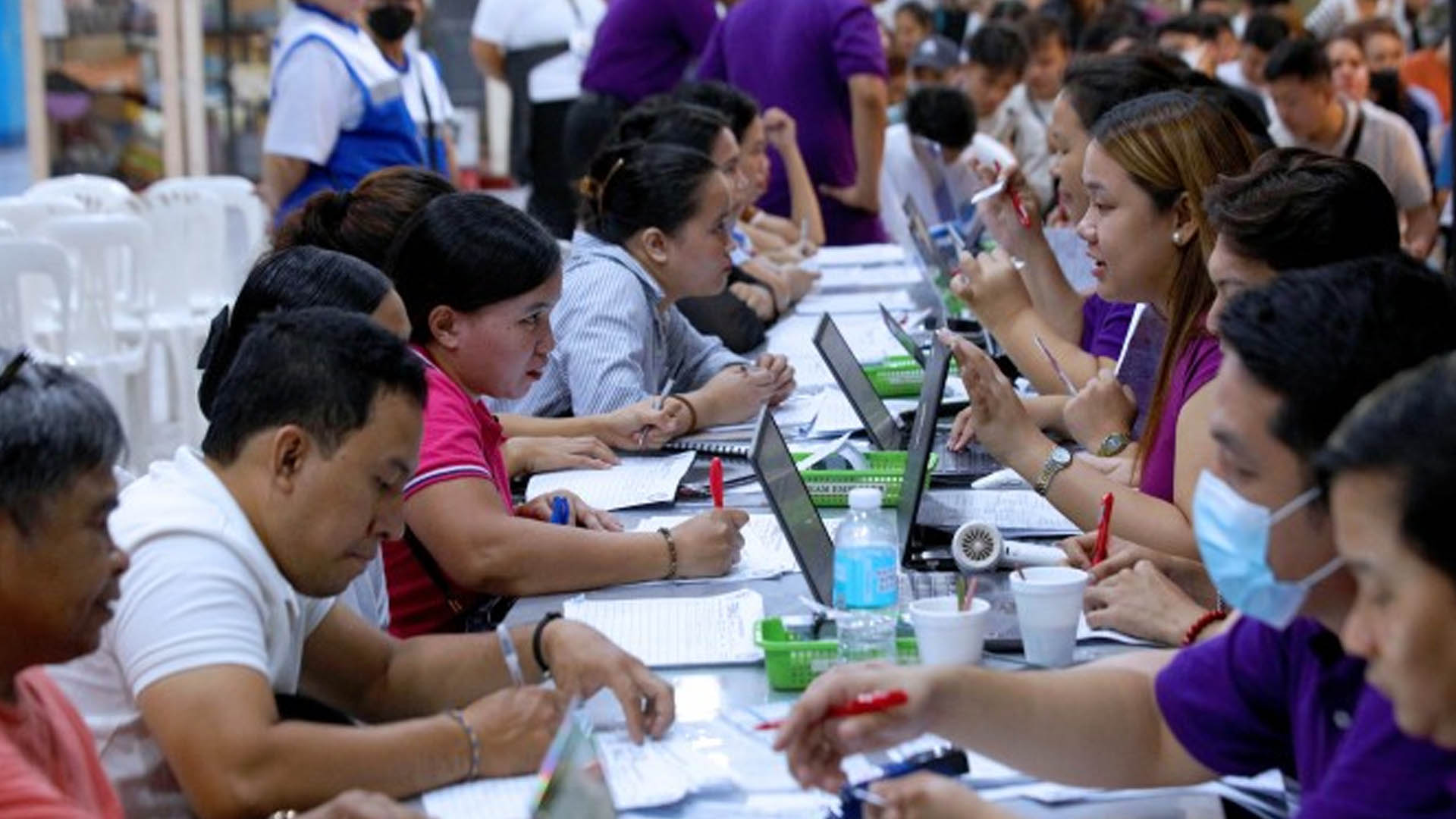







The government will strengthen the country’s labor market resilience amid emerging domestic and global challenges, the Department of Economy, Planning, and Development (DEPDev) said Tuesday.
DEPDev made the commitment after the Philippine Statistics Authority (PSA) released the results of the April 2026 Labor Force Survey (LFS).
In a briefing, National Statistician Dennis Mapa said the survey showed that the labor force participation rate (LFPR) in April was estimated at 62.7 percent, equivalent to 51.30 million Filipinos aged 15 years and over who were either employed or actively seeking work, lower than the 63.3 percent LFPR, or 51.65 million individuals in the labor force, recorded in March.
The number of employed Filipinos, meanwhile, increased to 48.89 million in April 2026 from 48.67 million a year earlier.
The employment rate during the month was estimated at 95.3 percent, with the services sector continuing to account for the largest share of employed workers at 62.3 percent.
The unemployment rate stood at 4.7 percent, higher than the 4.1 percent recorded in April 2025, as labor demand softened in sectors such as agriculture and wholesale and retail trade.
The underemployment rate also rose to 15.2 percent from 14.6 percent during the same period last year.
“The latest labor market indicators reflect both the challenges confronting the economy and the resilience of Filipino workers and businesses,” DEPDev Secretary Arsenio Balisacan said.
Balisacan said the government continues to monitor the employment and livelihood impacts of recent disruptions, including the Middle East crisis, the El Niño phenomenon, and the 7.8-magnitude earthquake in Mindanao.
“We remain committed to providing timely support to affected workers and households,” Balisacan said.
He said the government continues to provide assistance under the Unified Package for Livelihoods, Industry, Food, and Transport (UPLIFT) framework, while the inter-agency El Niño Task Force will be reconvened to help safeguard jobs and livelihoods, particularly in the agricultural sector.
Balisacan, however, cited the importance of strengthening business continuity and expanding opportunities for quality employment.
“We are working to broaden market access and attract investments in emerging industries, including artificial intelligence and other high-growth sectors, through strengthened economic partnerships and initiatives, such as the Luzon Economic Corridor,” he said.
Balisacan also called for stronger collaboration between government and industry to equip workers with the skills demanded by a rapidly evolving economy.
“The government is strengthening partnerships with the private sector to expand apprenticeship opportunities, improve certification systems, and support worker mobility toward high-value industries, such as advanced electronics, renewable energy, and digital services,” he said.
He said efforts are also underway to integrate job-formalization pathways into temporary employment programs, such as the Tulong Panghanapbuhay sa Ating Disadvantaged/Displaced Workers (TUPAD), enabling workers to transition to more stable, productive, and higher-quality jobs.
“These initiatives are essential to building a more resilient labor market that can withstand shocks while creating better opportunities for Filipino workers,” Balisacan said.
Meanwhile, the Department of Labor and Employment (DOLE) on Tuesday welcomed the continued rise in employment and labor market conditions as the unemployment rate declined for the fourth consecutive month in 2026.
In a statement, Labor and Employment Secretary Francis Tolentino attributed the improving employment and labor market conditions to the intensified implementation of livelihood initiatives.
He highlighted the critical need to strengthen the country’s school-to-work pipeline, emphasizing that Filipino youth must be actively prepared for the jobs.
He directed the nationwide DOLE TRABAHO AGAD (job fairs), which continue to connect job seekers with immediate employment opportunities, and expanded collaboration with educational institutions to support school-to-work transition programs. (PNA)