



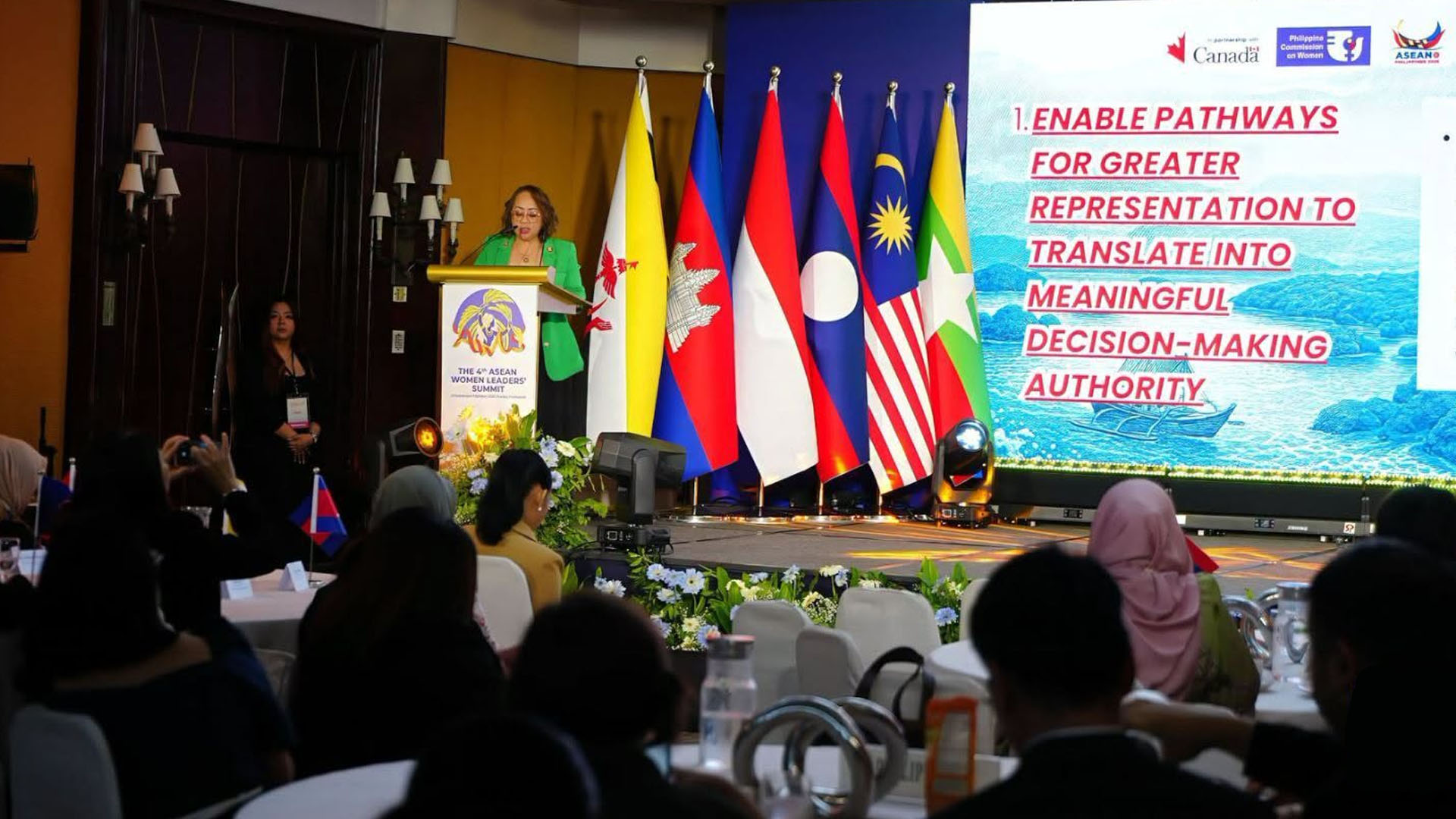







The 4th ASEAN Women Leaders’ Summit concluded with 10 strategic recommendations to strengthen women’s participation in decision-making and address barriers to leadership across the region.
In a news release Tuesday, the Philippine Commission on Women (PCW) said the recommendations will be integrated into the upcoming Joint Ministerial Statement on Women’s Leadership for Inclusive Prosperity.
The three-day summit brought together leaders, policymakers, sectoral experts and delegates from ASEAN Member States to discuss women’s leadership in governance, peace, climate resilience, technology and the economy.
ASEAN Committee on Women (ACW) Philippines Focal Point and PCW Executive Director Nharleen Santos-Millar presented the recommendations, which include strengthening pathways for women’s representation and decision-making and recognizing their leadership in disaster, peace and development structures.
They also call for addressing sector-specific barriers, mainstreaming gender equality across economic policies, and sustaining financing and institutional support through gender-responsive budgeting, research funding and growth capital for women in science, technology, engineering and mathematics (STEM).
Other recommendations include engaging men and boys as allies; recognizing, reducing and redistributing unpaid care work; strengthening sex-disaggregated data and monitoring; investing in young women leaders; and building on existing commitments.
“We did not start this summit at zero. We have strong foundations,” Santos-Millar said.
“We carry these forward to the next work and strategic plans for ASEAN Community Vision 2045.”
The summit also launched the Cambodia-led Women’s Political Participation and Leadership (WPPL) Study, developed in partnership with the European Union.
The study evaluated 18 key performance indicators across 10 ASEAN Member States, excluding Timor-Leste, to establish a benchmark for women’s leadership in executive, legislative, judicial and political party spheres.
It showed women’s representation at 37.56 percent in senior civil service appointments and 39.67 percent in judicial roles.
However, women occupied only 13.54 percent of ministerial positions and 21.20 percent of parliamentary seats across the region.
The study identified lower placement on party candidate lists, resource and financing constraints, online gender-based harassment and gaps in national sex-disaggregated data as obstacles to women’s political participation and leadership.
It recommended targeted policy mixes, affirmative action, political candidate financing, formal mentorship networks, family-friendly workplace protections and the integration of WPPL indicators into ACW’s post-2025 regional tracking framework.
Discussions on climate action highlighted the role of rural, indigenous and coastal women as frontline responders in disaster risk governance, with calls for direct resource allocation and their participation in climate resilience planning.
Sessions on STEM, innovation and economic integration focused on removing barriers in digital technologies and science, expanding access to capital for women-led micro, small and medium enterprises, and ensuring equal participation in the digital economy.
Panelists also urged greater participation of women in peace-building and conflict resolution decision-making.
Across the thematic sessions, participants identified the disproportionate burden of unpaid care and domestic work as a barrier to women’s leadership.
They recommended state-supported care infrastructure and social protection systems to recognize, reduce and redistribute care responsibilities. (PNA)